



The INSTI® HIV blood self-test analyzes a drop of your blood to detect HIV antibodies and provides a result within one minute.
This test is designed to detect HIV only. It cannot detect other STBBIs such as gonorrhea or syphilis.
You can take the test on your own at home, with a friend, or with the support of a community worker from Quebec’s community HIV network. Simply contact the HIV community organization nearest you to find out what type of support is available.
The self-test detects HIV antibodies. These antibodies defend the body against the virus from the early stage of infection. It can take 3 to 12 weeks (21 to 84 days) after exposure for the body to produce enough antibodies to be detected by the blood self-test.
To learn how to use the INSTI® self-test and get a reliable result in less than a minute, click on the short video below.
No time to watch the video? Simply follow those instructions:
 One single blue dot at the top of the circle: negative test
If you see one blue dot at the top of the circle, the test did not detect HIV antibodies and the result is negative.
 Two blue dots: positive test
If you see two blue dots, the test did detect HIV antibodies and the result is positive. In that case, you must see a healthcare professional for a blood test to confirm the result.
 No dots, or one single dot at the bottom of the circle: invalid test
If you do not see any dots or there is only one dot at the bottom of the circle, the test result is invalid, and you will need to repeat the test using a new self-test kit.
Whatever the result, the self-test must never be reused, as it is for single use only.
The INSTI® self-test should be used between 3 and 12 weeks after a possible exposure to HIV.
Why wait? Because the test can only detect HIV once your body has produced enough antibodies. In some cases, this may happen after 3 weeks, but in others it may take up to 12 weeks.
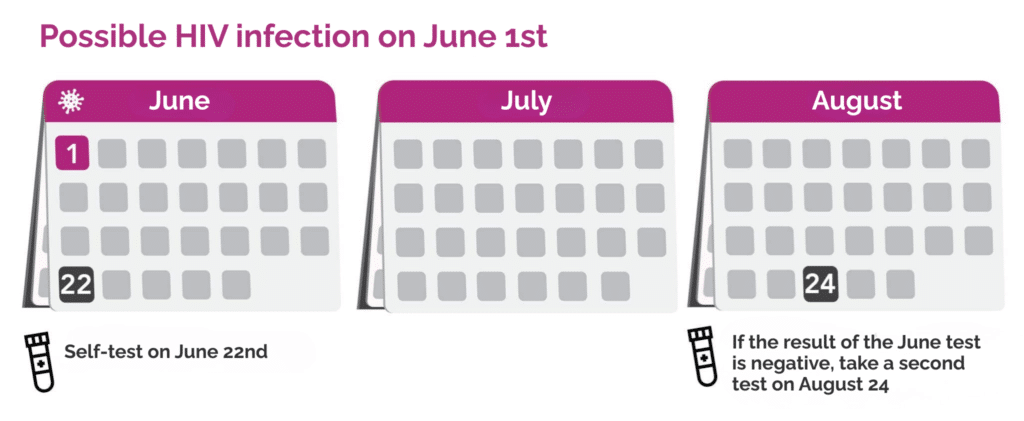
For example, if you think you were exposed to HIV on June 1, you should wait at least 3 weeks before taking the self-test, so from June 22 onward.
If the result is negative, it is recommended that you repeat the test, using a new kit, 9 weeks later (around August 24) to confirm the result.
If the self-test result is positive, there is no need to repeat the self-test. Instead, make an appointment with a healthcare professional for a confirmatory blood test.
Possible HIV exposures include:
One of the benefits of the HIV self-test is that you can choose how you want to do it: on your own, at home, with someone you trust, or with the support of a community worker.
A community worker can guide you through the process, help you interpret the result, and support you afterwards if needed.
Support options vary from one organization to another and may be available online, by text, by phone, or in person.
To find support near you, use the postal code search tool to locate the nearest community HIV resource.
You can purchase the INSTI® HIV self-test kit directly from the BioLytical website, the company that manufactures the test.
The cost is approximately $35 per kit, plus shipping and sales tax, for a total of about $57. Two tests cost approximately $85, including shipping and taxes. The kit can be delivered to the mailing address of your choice.
Until recently, a Canadian program made it possible for community HIV organizations to distribute self-tests free of charge. Unfortunately, that program has been discontinued, and most organizations no longer have enough kits for large-scale distribution. However, you can still contact the organization nearest you to see whether any tests are still available.
You now have a choice between a blood self-test and an oral self-test. A second HIV self-test was approved by Canadian health authorities in February 2026. Known as OraQuick®, this test uses a sample taken from the gums.
Learn more about OraQuick®!
Comparison table: INSTI blood HIV self-test vs. OraQuick oral HIV self-test
|
Blood (INSTI) |
Oral (OraQuick) |
|
|
Sample type |
Finger prick to collect a drop of blood |
Swab of the gums |
|
Time to get a result |
Less than 1 minute |
20 minutes |
|
What it detects |
HIV-1 and HIV-2 antibodies |
HIV-1 and HIV-2 antibodies |
|
Time between HIV exposure and possible detection |
Between 3 and 12 weeks (3 months) |
12 weeks (3 months) |
|
Cost |
$35 for one test, $55 for two tests, plus taxes and shipping |
$20 per test, plus taxes and shipping |
|
Storage temperature |
2-30 °C Use the test between 15 and 30 °C |
2-27 °C |
|
Where to get it |
Through the manufacturer’s website or through certain community organizations |
Online (minimum order of 25 tests) |
|
Results |
||
|
Positive |
Take a confirmatory test (standard blood test at a clinic) |
Take a confirmatory test (standard blood test at a clinic) |
|
Negative |
If needed, repeat the test 3 months after the possible exposure to HIV |
If needed, repeat the test 3 months after the possible exposure to HIV |
|
Invalid |
Repeat the test using a new kit |
Repeat the test using a new kit |
What should you do if the result is positive?
A positive HIV self-test result must always be confirmed with a standard blood test at a clinic. Check the map of testing locations to find a place near you.
Getting a positive result is not easy, even though people can now live comfortably with HIV. If possible, reach out to someone you trust for support. You can also contact the community HIV organization nearest you for psychosocial support or help navigating the healthcare system.
While waiting for the result to be confirmed, choose with your partner or partners the most effective prevention methods to avoid possible transmission of the virus.